
 English
 русский
 Español
 عربى

Content
- 1 From Pellets to Roll: the Process in Order
- 2 The Components That Decide Whether the Film Is Saleable
- 3 Resin Choice Changes the Machine, Not Just the Recipe
- 4 Bubble Instability and Gauge Bands: the Faults That Return
- 5 Where Blown Film Meets Coating, Laminating and Panel Lines
- 6 What to Put in the Inquiry
A three-layer line running at 300 kg/h with a 5 percent gauge spread across a 1,600 mm bubble will keep producing film that fails a 20 micron specification, and most of that scrap never appears as its own line on the daily production report. The lesson is not that thin film is hard to make. It is that a film blowing machine is judged on three numbers: gauge tolerance, stable output, and the haul-off speed at which the bubble still behaves.
In short, a film blowing machine melts polymer pellets, pushes the melt through an annular die, inflates the tube with internal air, cools it with an air ring, and collapses it into lay-flat film on a winder. Every extra feature on the machine exists to keep those five steps repeatable from shift to shift, and every purchase decision should be traced back to one of them.
From Pellets to Roll: the Process in Order
Blown film is a continuous process with no accumulator between the die and the winder, so a disturbance anywhere shows up downstream within seconds. That is why the sequence matters more than the individual components.
- Feeding and dosing. Pellets, regrind and additives are metered by weight so the layer ratio stays constant when line speed changes.
- Melting and pumping. A screw with a barrier or mixing section melts and homogenises the polymer; melt pressure and melt temperature at the die inlet are the two values worth logging every hour.
- Filtration. A screen changer traps gels and contamination. Continuous or backflush designs avoid stopping the line for a screen change.
- Annular extrusion. The melt is distributed around a spiral mandrel and leaves through a ring-shaped gap, typically 0.8 mm to 2.5 mm, which sets the starting wall thickness.
- Inflation and cooling. Air admitted through the die centre inflates the tube to the target bubble diameter, while the air ring removes heat from the outer surface.
- Stabilisation and collapsing. A cage keeps the bubble concentric, then the collapsing frame and nip rolls flatten it into two layers without creases.
- Treatment and winding. Corona treatment raises surface energy for later printing or lamination, and the winder builds the roll at a controlled tension taper.
Two ratios describe almost everything about the finished film. The blow up ratio is bubble diameter divided by die diameter. The draw down ratio compares die gap with final thickness at a given output. Low density polyethylene usually runs at a blow up ratio of 2:1 to 3:1, while high density grades need a higher ratio and a longer neck to develop stiffness. Frost line height, the point where the melt solidifies, links the two, and it is the first parameter to adjust when the film feels soft or the bubble starts to sway.
The Components That Decide Whether the Film Is Saleable
Two machines with the same quoted output and the same die diameter can produce very different film. The gap is almost always in the details below.
| Component | What it controls | What to verify |
|---|---|---|
| Extruder screw and barrel | Melt quality and output stability | Screw length to diameter ratio, mixing or barrier section, zone temperature control |
| Screen changer | Contamination removal and pressure stability | Continuous or manual type, screen area, pressure differential alarm |
| Annular die head | Gauge distribution and layer uniformity | Spiral mandrel design, gap adjustment range, number of layers |
| Air ring | Cooling rate and bubble stability | Single or dual lip, internal bubble cooling, airflow uniformity around the circumference |
| Bubble cage and stabiliser | Bubble shape and frost line height | Adjustable diameter range, roller condition, freedom from vibration |
| Collapsing frame and nip rolls | Lay-flat quality and wrinkle control | Roller alignment, nip pressure consistency, edge trim arrangement |
| Winder | Roll hardness and tension profile | Tension taper control, maximum roll diameter, shaft type |
| Gravimetric dosing and thickness scanner | Gauge tolerance and resin cost | Closed-loop control, scan rate, ability to log a full width profile |
Ask for a gauge map across the bubble rather than a single thickness reading. A line that holds 4 percent across the full lay-flat width at the production speed you actually intend to run is worth more than a line that reaches 2 percent only at half speed.
Resin Choice Changes the Machine, Not Just the Recipe
A line specified for low density polyethylene will not run high density film simply by changing the setpoints. High density grades need a narrower die gap, a different air ring setting and a taller tower, because the bubble has to travel further before it solidifies. Buying a short tower to save headroom and then discovering that the output is cooling limited is one of the more expensive ways to learn this.
Co-extrusion adds a second variable. Three layers are enough for most seal and stiffness combinations, but barrier structures need five or more, with tie layers between the polyolefin and the barrier resin. If a three-layer line is pushed into a barrier job without tie layers, the film will look acceptable on the roll and delaminate in the customer's warehouse. Match the layer count to the product, not to the budget alone.
Bubble Instability and Gauge Bands: the Faults That Return
Two failures account for most rejected film on a working line, and they are often confused because both look like thickness variation.
Helical instability appears as a regular spiral pattern that travels around the bubble. It is a cooling and tension problem: the melt is too hot, the air ring is removing heat unevenly, or the haul-off is running faster than the frost line can support. Draw resonance is the related symptom, a periodic oscillation in bubble diameter and thickness that grows until the operator slows the line. Reducing output usually proves the diagnosis.
Gauge bands are different. They stay in the same angular position, so marking the bubble with a chalk line at the die reference point will show whether the stripe rotates with the film or stays fixed. A fixed stripe points to die flow distribution, a partly blocked screen or screw surge, and no amount of air ring adjustment will remove it. Instability is a heat transfer and tension problem; gauge bands are a flow problem. Treating one as the other can waste weeks.
Where Blown Film Meets Coating, Laminating and Panel Lines
Most plants that buy a film blowing machine do not run it in isolation. The film leaves the winder and goes straight into a printing press, a bag machine, or a laminating line where it is bonded to a coil, a board or a leather substrate. The interface between the two machines is where a large share of film-related defects actually originate, long after the extruder has been cleared of blame.
Three properties matter most at that interface. Gauge variation changes the tension profile in the laminating nip, so a roll that is fine at the core can wrinkle at the outside. Corona treatment decays over time, which means a dyne level measured at the winder may not survive a week in storage; treat to a target and use the film within a defined window. Slip and antiblock additives migrate to the surface and can reduce adhesion on a PUR laminating line, so the additive package has to be agreed with the lamination process, not chosen independently.
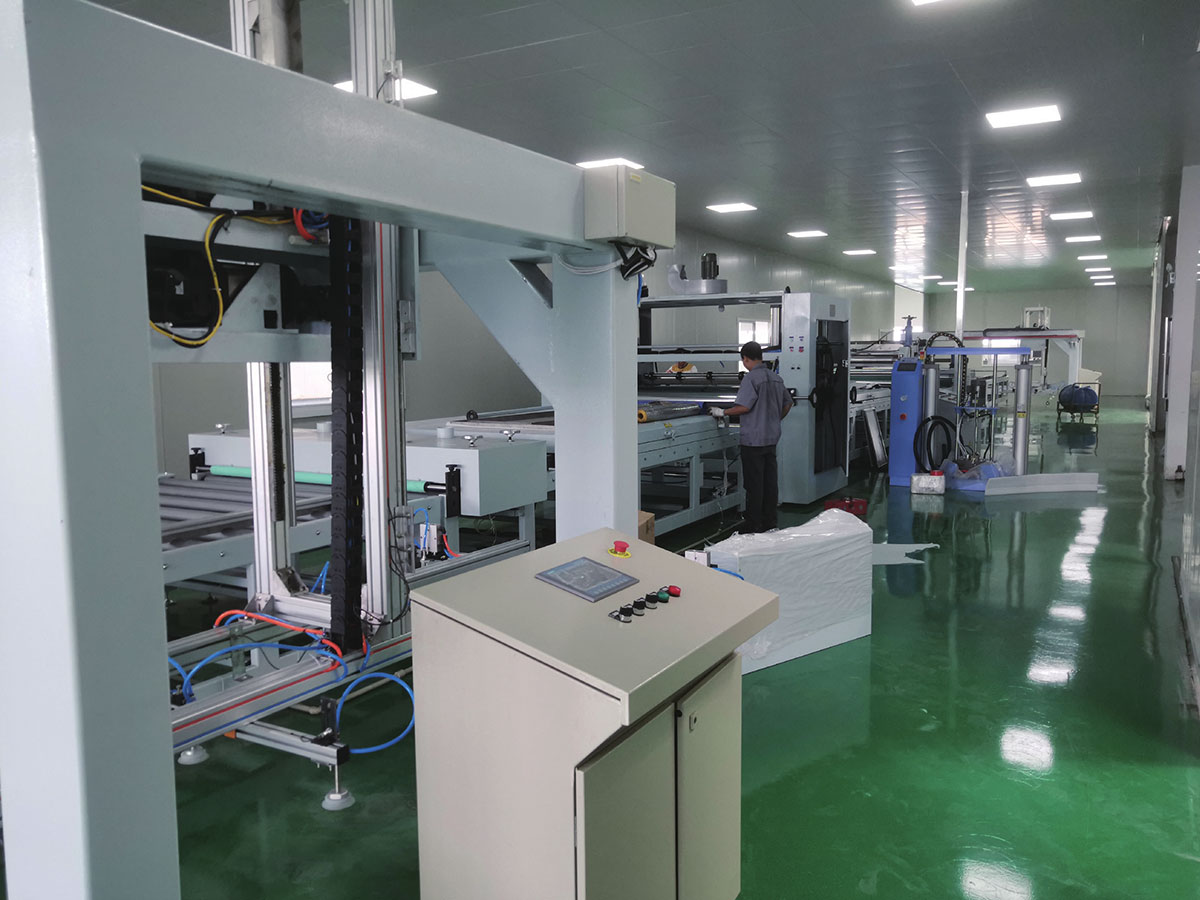
 PUR Coating and Film Laminating LineFor matching film tension and adhesive behaviour, this line combines PUR metering, precise coating and tension-controlled lamination.View Product →
On the coating side, film tension and elongation have to match what the laminating unit can absorb. A film with high stretch will follow the web speed but keep deforming after the nip, which shows up as curl or edge wave in the finished panel. Reviewing the laminating equipment and the film specification together avoids that argument later.
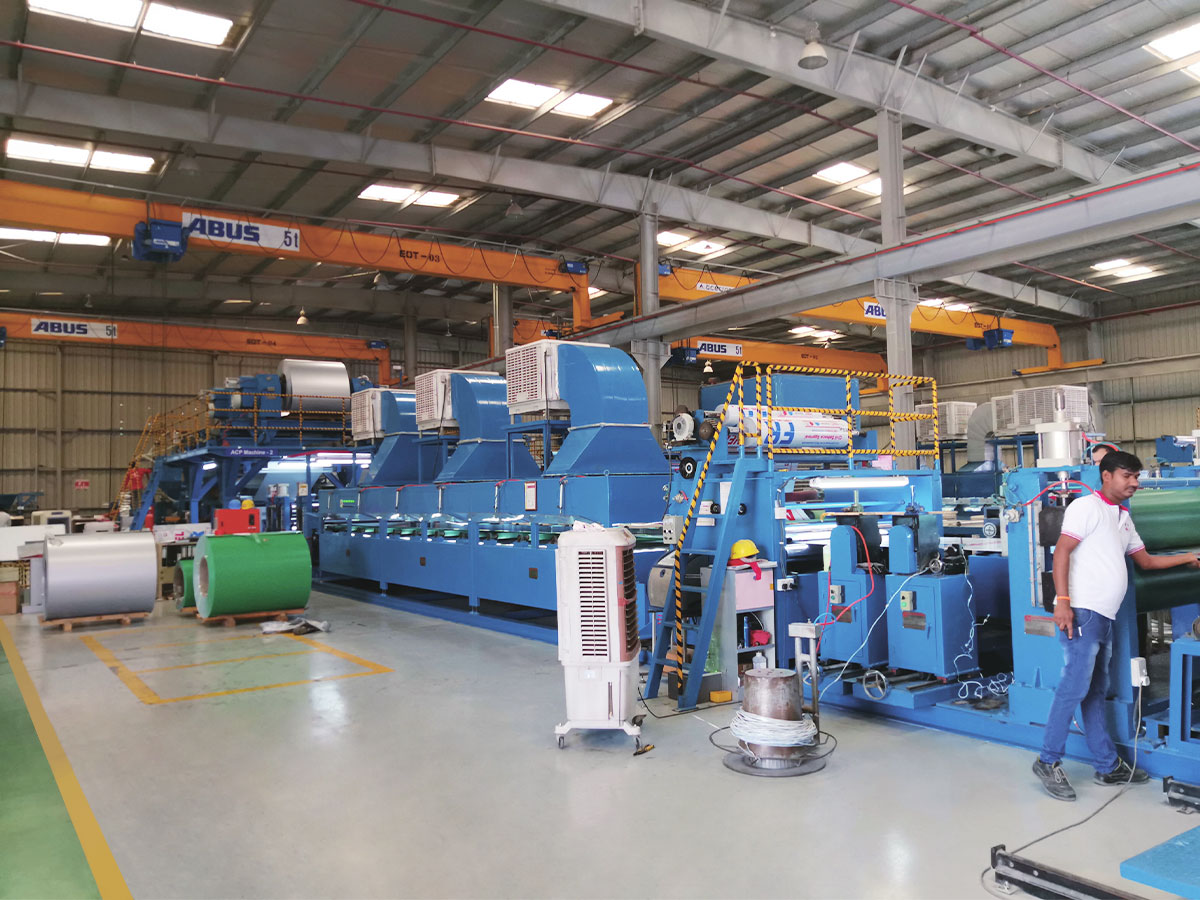 Protective Film Lamination Production Line for Sheets and WorkpiecesFor protective film application on plates and formed workpieces, this line uses tension control and precision lamination to avoid bubbles and wrinkles.View Product →
For converters already coating metal coil, the same logic applies to the surface preparation step before lamination. The methods and quality checks described in this overview of metal coil coating line production advantages are a useful reference point when the film is being bonded to a coated substrate rather than a bare one.
What to Put in the Inquiry
Suppliers quote against whatever information the buyer provides, so a vague inquiry reliably produces an optimistic number. The list below covers what a serious specification should contain.
- Resin types and layer structure, with the percentage of each layer stated.
- Target thickness range, and the gauge tolerance required across the full lay-flat width.
- Output in kg/h at the target thickness and target quality, not the maximum figure on the brochure.
- Die diameter and the blow up ratio range you expect to use in production.
- Roll diameter, core size and tension range required by the downstream machine.
- Corona treatment on one or both sides, and the dyne level that must be achieved.
- Available tower height and floor space, since these cap cooling capacity and therefore output.
- Downstream process, printing, lamination or bag making, because it sets the slip and antiblock specification.
A supplier who asks about the tower height and the downstream process before quoting is usually the one who has installed a line in a building with a low roof before.
Blown film quality is decided by cooling, tension and flow distribution, and all three are fixed at the specification stage rather than during commissioning. Buying on quoted maximum output alone tends to produce a line that runs well below that figure in daily production, with the shortfall absorbed by the operator instead of the supplier.
If the film from your blowing line feeds a coating, laminating or composite panel process, it is worth reviewing both sides together. Our engineers work on the equipment downstream of the winder every day and can discuss the film handling interface with your team before the specification is fixed.