
 English
 русский
 Español
 عربى

Content
- 1 What High Output Actually Means on a Film Blowing Machine
- 2 Extruder and Screw Design That Makes Output Repeatable
- 3 Die Head and Air Ring: Where Output Is Won or Lost
- 4 Cooling, Bubble Stability and Haul Off Speed
- 5 Winding, Automation and the Cost of Downtime
- 6 Utilities and Operating Cost Behind the Number
- 7 Why Film Consistency Travels Downstream into Lamination
- 8 How to Verify Output Before You Sign
- 9 What to Ask a Supplier
A converter comparing two film blowing machines with the same 75 mm screw will often see one quoted at 320 kg per hour and the other at 400 kg per hour. The gap rarely comes from the screw alone. It comes from how the die, air ring, cooling, haul off and winder behave together at the higher rate. The short version is this: high output on a thin film blowing machine is a system property, and the features that matter are the ones that hold gauge, melt temperature and bubble stability steady across a full shift, not just during the first hour after start up.
What High Output Actually Means on a Film Blowing Machine
Rated output is the easiest number to quote and the hardest number to use. A machine rated at 450 kg per hour may reach that figure only with a specific resin, a specific die diameter and a relatively thick film. Thin film is where output claims are really tested, because thin gauges demand higher haul off speeds and shorter cooling times for the same mass of melt.
Three measurements separate real output from brochure output:
- Usable kilograms per hour measured at the target film thickness and layflat width, not at a convenient heavy gauge.
- Specific energy consumption in kWh per kilogram of finished film, which shows whether extra output is coming from better engineering or simply from a larger motor.
- The length of a stable continuous run, because a line that holds 380 kg per hour for three days at consistent gauge is worth more than one that touches 450 kg per hour for twenty minutes.
| Parameter | Entry level | Mid range | High output |
|---|---|---|---|
| Screw diameter | 45 to 55 mm | 55 to 75 mm | 75 to 90 mm |
| Screw length to diameter ratio | 28:1 to 30:1 | 30:1 to 33:1 | 33:1 to 36:1 |
| Output on LDPE | 80 to 150 kg per hour | 150 to 350 kg per hour | 350 to 600 kg per hour |
| Specific energy | 0.55 to 0.75 kWh per kg | 0.45 to 0.60 kWh per kg | 0.35 to 0.50 kWh per kg |
| Typical gauge tolerance | 8 to 10 percent | 5 to 8 percent | 2 to 5 percent |
| Cooling method | Single lip air ring | Dual lip air ring | Dual lip with internal bubble cooling |
| Take off speed | 30 to 50 m per minute | 50 to 80 m per minute | 80 to 120 m per minute |
Extruder and Screw Design That Makes Output Repeatable
Output per revolution is set by screw geometry, and the features that raise it are well established. A barrier screw with a dedicated melting zone and a separate solids channel melts the resin earlier, which shortens the unmelted stretch and allows a higher screw speed before melt temperature reaches its ceiling. Grooved feed sections can add a useful margin of throughput on the same diameter, especially with HDPE, because they prevent the resin from slipping on the barrel wall.
Screw length to diameter ratio matters for a practical reason. A 33:1 or 36:1 screw gives the melt more time to homogenise, so a line can be pushed harder without cold spots or gels appearing in the film. Shorter screws are cheaper and fine at moderate rates, but at high rates they often force the operator to choose between output and melt quality.
Pressure stability is an output feature
A machine running at 400 kg per hour is only useful if that 400 kg per hour is even. Pressure fluctuation at the die changes bubble diameter, frost line height and, eventually, gauge. A melt pump between the extruder and the die, combined with a continuous screen changer, typically holds pressure within one percent and lets the extruder run at a steadier speed. Without that combination, the operator ends up trimming output to keep the bubble calm, which is why two machines with identical screw diameters can behave so differently in production.
Die Head and Air Ring: Where Output Is Won or Lost
The die sets the thickness distribution before the film is ever cooled. A spiral mandrel design with a low pressure drop and short residence time lets the melt spread evenly at high throughput without building up the shear that causes melt fracture and die lines. Die gap choice is a compromise: a wider gap reduces shear stress at high output, but it demands more cooling capacity and tighter bubble control.
Air ring design has become the single largest lever on high output thin film lines. A dual lip air ring stabilises the bubble and increases heat transfer at the frost line. Internal bubble cooling goes further by removing heat from inside the bubble as well, and on many lines it lifts practical output by twenty to forty percent without changing the extruder at all. Automatic bubble cooling control, driven by a thickness scanner, adjusts air volume and temperature continuously so the frost line stays fixed while the line runs at maximum speed.
The result shows up as gauge tolerance. A line holding 2 to 5 percent thickness variation uses less resin per square metre of finished film than one drifting between 8 and 10 percent, because the operator of the looser line has to run a heavier average gauge to stay above the minimum specification.
Cooling, Bubble Stability and Haul Off Speed
Thin film leaves the die with very little thermal mass, so cooling is what actually limits line speed. Chilled air temperature, humidity and the volume delivered to the air ring all need to be held within narrow bands, and the cold air supply should be sized for the highest ambient summer condition rather than a mild spring day. Bubble cages, stable guide rolls and a properly tuned oscillating haul off keep the bubble from breathing as speed rises.
Haul off and winder tension control are equally part of the output story. A high speed line with a slow or inaccurate roll change cycle loses its advantage in stops and starts, and each restart costs several minutes of scrap while the bubble is re established.
Winding, Automation and the Cost of Downtime
At 100 m per minute, a winder that needs manual roll changes becomes the bottleneck. Automatic roll change, taper tension control and closed loop tension feedback are therefore high output features in their own right, not accessories. On the control side, recipe storage, thickness scanner feedback and remote diagnostics reduce the time between a resin change and a stable bubble, and they let a supplier support tuning without waiting for a site visit.
Utilities and Operating Cost Behind the Number
Buyers should compare installed power with measured power draw, not with the nameplate alone. A well designed high output line of the same throughput can draw noticeably less current because the motor, gearbox and heating zones are matched to the actual load. Cooling water flow and temperature, compressed air at 6 to 8 bar for the air ring and treatment equipment, floor space for the tallest possible bubble, and noise levels all affect whether the line fits an existing building. Maintenance intervals belong in the same conversation: screw and barrel wear, air ring cleanliness and filter changes are what determine whether the machine still delivers its rated output in year five.
Why Film Consistency Travels Downstream into Lamination
Blown film rarely ends its journey at the winder. Polyethylene film acts as a protective layer, a tie layer or an interleaving film on metal composite panel lines and coil coating lines, and those processes are far less forgiving of gauge bands and width variation than a printing or bag making operation. A lamination line set to run at a fixed speed will show streaks, trapped air or inconsistent bond strength when the incoming film varies in thickness across the web.
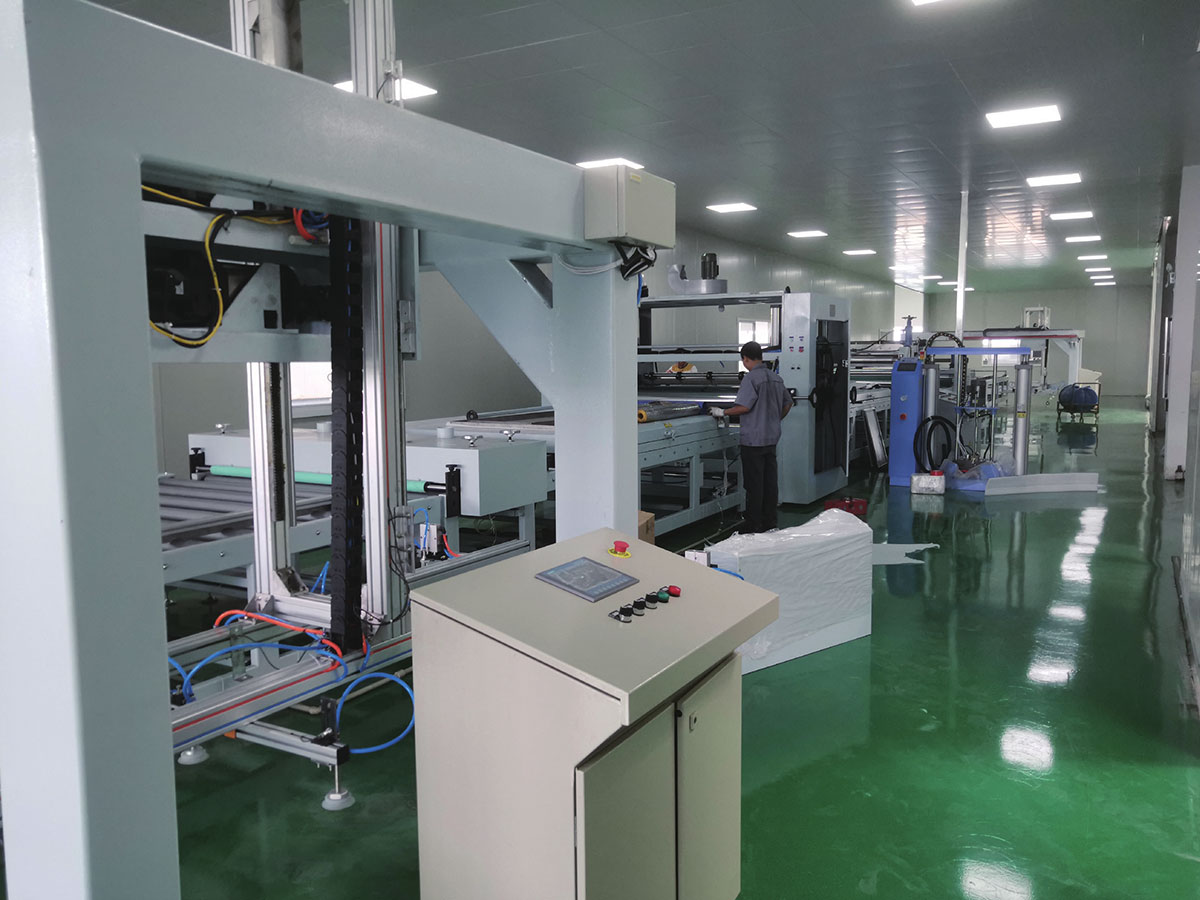
 PUR Coating and Film Laminating LineFor film-to-metal coil lamination, this line uses PUR reactive hot melt adhesive and precision coating to support smooth, bubble-free bonds.View Product →
For converters who laminate film onto aluminium or steel coil, the film specification and the lamination equipment have to be developed together. Corona treatment level, blocking behaviour, gel count and roll diameter consistency all influence how the film behaves in a PUR laminating nip, and a film that runs perfectly on a bag machine can still cause problems on a coil line running continuously for hours.
 Film Lamination Production Line for Protective Film ApplicationFor applying protective film to plates, sheets, and formed workpieces, this line offers tension control and clean peeling to reduce bubbles, wrinkles, and waste.View Product →
This is where the equipment supplier's wider experience helps. If you are reviewing how film handling fits into a complete panel or coil process, the production line portfolio shows the matching upstream and downstream equipment, from pretreatment and coating through to laminating and finishing.
How to Verify Output Before You Sign
Output guarantees should be written against a named resin, a named film thickness and a named layflat width. Anything vaguer is difficult to enforce. A practical acceptance test covers the following:
- A continuous run of at least 72 hours at the guaranteed output, with all film meeting the agreed gauge tolerance.
- Recorded melt temperature and pressure stability at the die during the full run, not only at the start.
- Measured specific energy consumption in kWh per kilogram, taken from a calibrated meter.
- Scrap rate during start up, roll change and resin transitions.
- Film properties checked against specification, including tensile strength, dart impact and haze.
- Noise level and surface temperature at operator positions.
It also pays to ask what happens at the edges of the operating window. What output can the line hold with a lower melt index resin, or at the thinnest gauge in the product range? Those answers reveal whether the quoted figure is a comfortable working point or an absolute ceiling.
What to Ask a Supplier
The features of a high output thin film blowing machine are not mysterious: a properly proportioned barrier screw, stable pressure through a melt pump, a low shear spiral die, a strong air ring with internal bubble cooling, generous and well controlled cooling, and a winder that keeps up with the haul off. What separates suppliers is how honestly those elements are matched to your resin, your thickness range and your downstream process. Bring the film specification and the lamination or converting step that follows it, and share both with our engineers so the output guarantee is built around the film you actually need to sell.